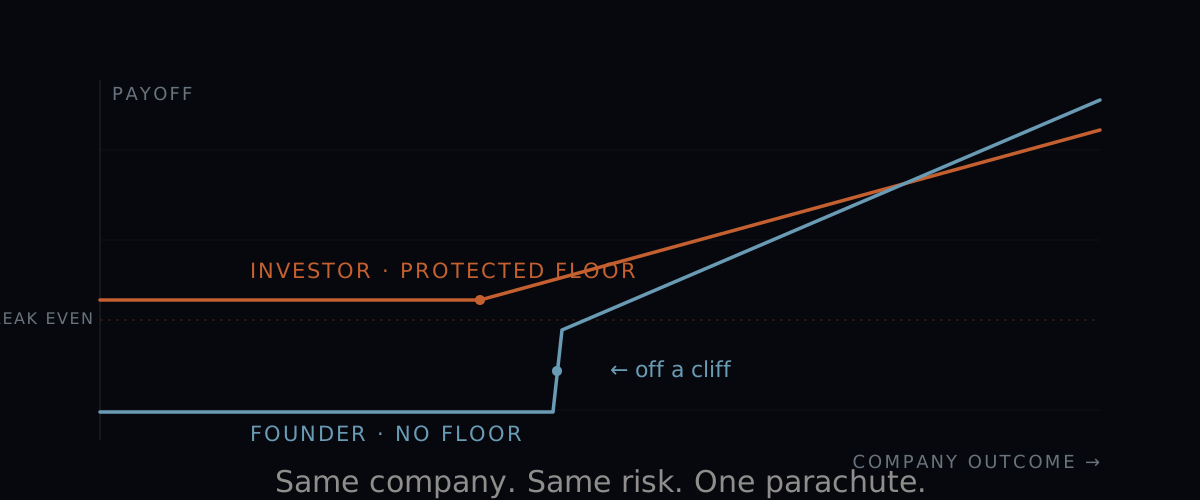
Last year, roughly 5.2 million new businesses were registered in the United States.1 A few thousand of them will raise venture capital. And every founder who does is about to sign into a structure where they carry the most risk, do the most work, and stand last in line when the money is handed out.
That's not a complaint about any individual investor. It's a description of the sad state of affairs of the industry. It seems that the battle between Capital and Labor is alive and well in Venture Capital: The standard venture deal is built so that the person with the least protection is the person doing all the hard work. But, it doesn’t have to be that way — and founders are entirely within their rights to fix it.
What the founder signs up for
Start with what the founder actually puts on the table.
They put in their money — often their entire savings, sometimes the equity in their house. They put in their time: surveys of startup founders routinely find a majority working more than 80 hours a week, and a meaningful slice past 100.2 They put in their twenties, or their thirties, or forties — the decades most people spend compounding a salary and a retirement account. They run sales until there's a sales hire, finance until there's a finance hire, recruiting, support, and engineering in between. More than half report sleeping less than six hours a night.2
And they do all of it for a pay cut. The average seed-stage founder pays themselves around $133,000 a year; at pre-seed it is closer to $50,000.3 The same person, with the same résumé, could walk into a senior role at a large technology company for two to four times that — in cash, liquid, every year, with none of the risk. That gap is not a rounding error. It is a multi-year, six-figure-a-year bet the founder is making on their own equity, before anyone has handed them a term sheet.
So by the time the financing closes, the founder has already wagered their savings, their time, their health, and their earning power.
What the investor signs up for
Now look at the other side of the table.
The venture investor is also taking risk — real risk, on a portfolio of companies most of which will not work. But the structure they operate inside is engineered, carefully and deliberately, to protect them. Three features do most of the work:
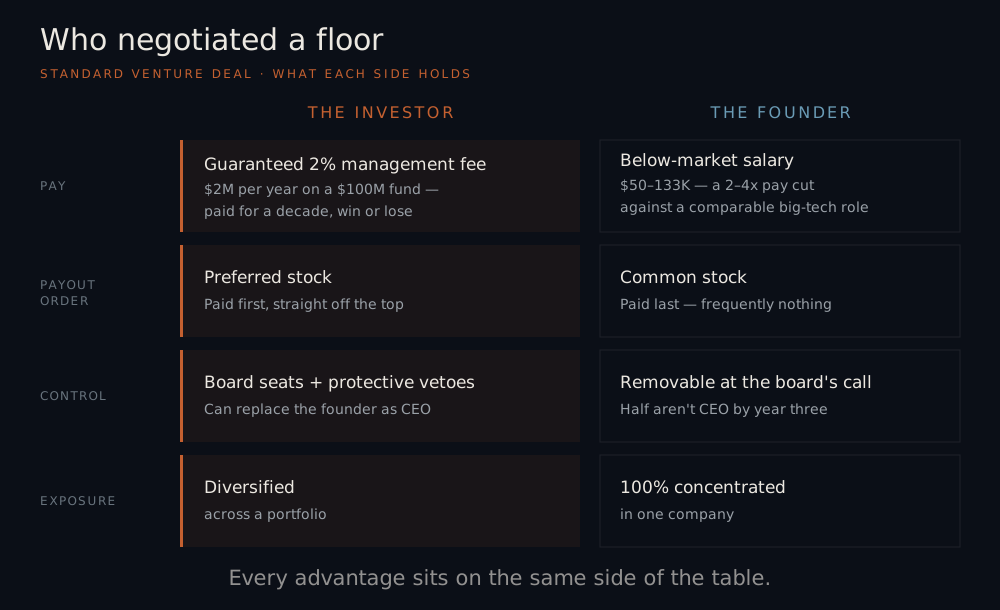
The management fee. A venture fund typically charges its limited partners around 2% of committed capital every year, for the life of the fund — usually ten years. That fee is paid regardless of whether the fund ever makes anyone a dollar. Across a fund's life it adds up to roughly 15% of committed capital.4 On a $100 million fund, that is about $15 million the investing team is paid no matter what happens. Call it what it is: a salary, guaranteed for a decade, decoupled from performance. Completely risk free.
The liquidation preference. Venture investors buy preferred stock, and preferred stock gets paid first. When the company exits, investors take their money off the top — often the full amount they put in, sometimes a multiple of it — before common shareholders (like the founders) see a cent. Founders and employees hold common. They are, by the plain terms of the investment documents, last in line when it comes to cash out.
Governance and control. Board seats and protective provisions hand investors a veto over the decisions that matter (like raising capital and debt, entering new markets...) — and, frequently, the ability to replace the founder as CEO.5 This is not a rare edge case. In Noam Wasserman's study of roughly 212 startups, half of all founders were no longer CEO by the time the company turned three.6
Guaranteed pay. First in line. Control when it counts. The investor negotiated themselves a floor on every axis that the founder left exposed.
Now look at who actually gets paid
Here is where the structure stops being abstract.
Roughly three out of four venture-backed startups never return their investors' capital.7 In every one of those companies, the founder's equity — the thing they took the pay cut and the sleepless years for — is worth nothing. The investor, meanwhile, has been drawing the management fee the entire time.
And the failures are not even the toughest part. The toughest part is the "successes," because a liquidation preference means a company can sell for real money and the founder can still walk away with zero.
The textbook case is Trados. The company sold for $60 million — by any normal definition, a win. But the preferred stockholders' liquidation preference was $57.9 million. A management incentive plan took the first $7.8 million; the preferred took $52.2 million. The common stockholders — the founders and the employees — received nothing.8 A $60 million outcome, and the people who built the company got zero.
Trados is a court case only because someone sued. The math behind it is completely routine. More than 80% of startup acquisitions happen below $200 million, and a large share of those land at or beneath the capital raised.9 In all of them, the preference stack gets paid and the founder takes the residual — which is frequently a rounding error.
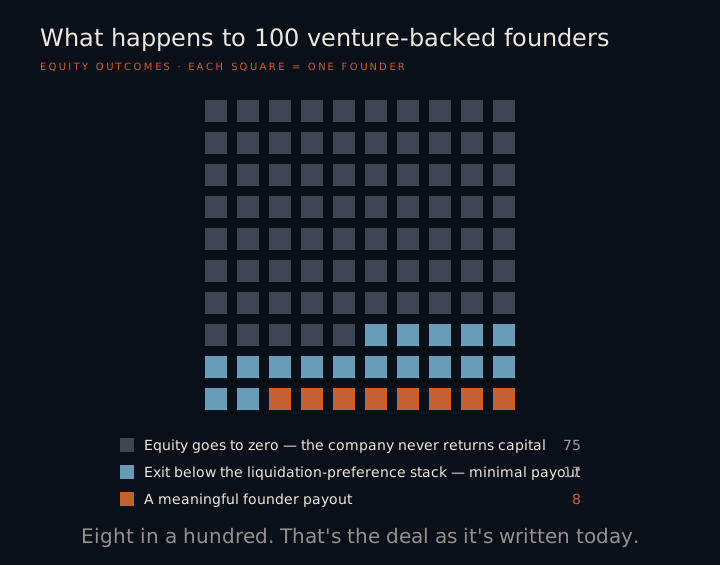
So, looking at the whole picture: The founder takes the most risk. Does the most work. Accepts the lowest pay. And then, in the most likely outcomes, takes home the least — often nothing — while the investor has been paid a fee the whole way through and stands ahead of them in line for whatever is left.
The person doing the work and carrying the risk is, by design, the worst-protected party in the deal.
This is not an argument against venture capital
It is worth clarifying, because the point is easy to misread.
None of this makes venture investors villains, or their protections illegitimate. LPs are entitled to a fee in exchange for a decade-long lockup. Preferred stock earns its preference. Governance rights exist for real reasons. Venture capital has funded an enormous amount of the largest and most successful companies in the world.
The argument is narrower, and harder to wave away: every other party at the table has negotiated downside protection for themselves, and the founder is the only one who has not. The LP has it. The GP has it. The preferred shareholders have it. Lenders have it. The structure is not unfair because protection exists — it is unfair because protection exists for everyone except the person taking the most risk.
Why we built what we built
In our last piece, Why Founder Parachutes Produce Bigger Outcomes, we drew the payoff curve of a founder with downside protection — a floor on the left, uncapped upside on the right. Here is the uncomfortable thing about that curve: it already exists on your cap table. It just is not yours. It belongs to your VC investors.
Rising Tide builds the version of that downside protection that belongs to the founder. EFLF lets seed-stage founders move a slice of their equity into a diversified basket of their cohort, so their outcome is not a single binary bet on one door. EFDPF puts an actual floor under a founder's position from Seed through Series C. ECLF does the same at late stage, for founders sitting on paper net worths they cannot touch and cannot afford to watch evaporate.
These are not charity — they are financial instruments, with eligibility rules and real mechanics. But the reason they exist is simple: The founder is the only person in the building who took the deal without a parachute. They should be allowed to pack one.
The ask
The next time a founder is told that wanting downside protection means they are "not committed," it is worth remembering who tends to say it — and what that person already holds.
The investor has a floor. The founder has a cliff. Asking to stand a little closer to level ground is not a lack of conviction. It is the most rational move available to the hardest-working person in the deal.
References
[1] U.S. Census Bureau, Business Formation Statistics; summarized in Commerce Institute, "How Many New Businesses Are Started Each Year?" (~5.2 million new business applications, 2024). commerceinstitute.com
[2] Founder working-hour and sleep figures as compiled from CB Insights survey data and related startup-founder surveys (majority working 80+ hours/week; ~57% sleeping under six hours/night). See, e.g., Karl Hughes, "Startup Working Hours." karllhughes.com
[3] Kruze Consulting, "Average Startup Founder Salaries"; TechCrunch, "Here's what seed-stage founders pay early employees" (Dec. 2024). Seed-stage founder salaries average ~$133K; pre-seed ~$50K. kruzeconsulting.com
[4] On the 2% management fee paid regardless of performance and totaling ~15% of committed capital over a fund's life: Emmanuel Maggiori, "How venture capitalists make millions regardless of results"; Kruze Consulting, "The 'Two and Twenty' VC Fee Structure Explained." emaggiori.com
[5] The Holloway Guide to Raising Venture Capital, "How VCs Can Control Your Company" — on protective provisions, board seats, and investor influence over CEO hiring and firing. holloway.com
[6] Noam Wasserman, "The Founder's Dilemma," Harvard Business Review (Feb. 2008). Across ~212 startups studied, 50% of founders were no longer CEO by year three. hbr.org
[7] On venture-backed failure rates (~75% never return investor capital): Harvard Law School Forum on Corporate Governance, "Startup Failure" (2023); Failory, "Startup Failure Rate." corpgov.law.harvard.edu
[8] In re Trados Inc. Shareholder Litigation, 73 A.3d 17 (Del. Ch. 2013). $60M acquisition; $57.9M liquidation preference; $7.8M management incentive plan; $52.2M to preferred; common stockholders received nothing. Delaware Court of Chancery opinion
[9] On the distribution of startup M&A outcomes (80%+ of acquisitions below $200M; large share at or below capital raised; ~50% of tech acquisitions structured as acqui-hires): GoingVC, "Exit Engineering"; They Got Acquired, "Do founders get paid if they sell for less than they raised?" theygotacquired.com
This piece is commentary, not investment or legal advice. EFLF, EFDPF, and ECLF are private offerings subject to eligibility and standard securities-law restrictions.