Walk into any pitch meeting and you'll hear some version of the same line: we're founder-friendly, founders are our number one priority, we work for you. It’s all over the website, their email signature, and it’s their entire brand.
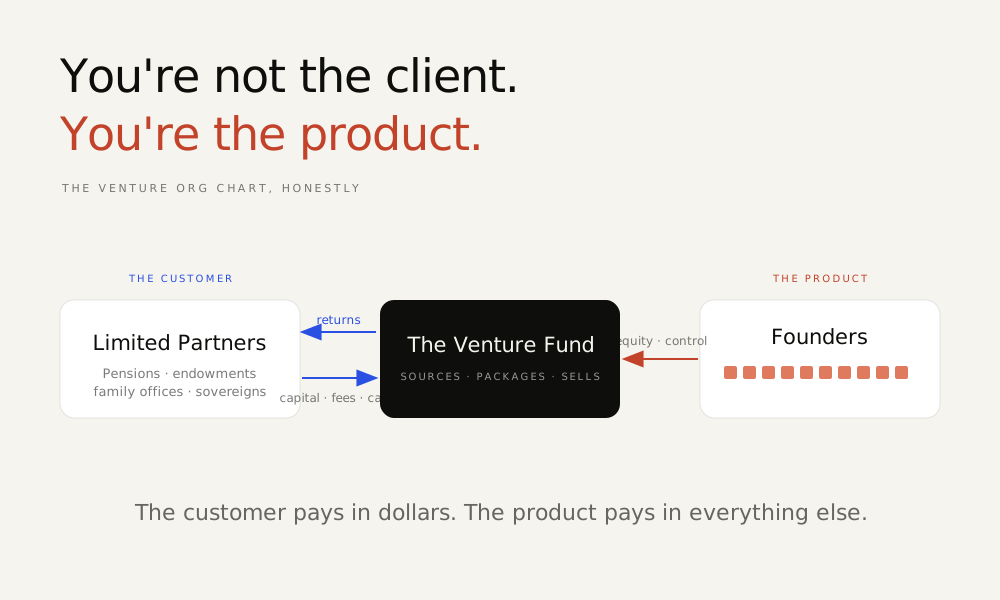
The problem is it's also not true. Not because VCs are villains — most aren't — but because of a structural fact that the industry has spent forty years getting founders to look away from: A venture fund has exactly one customer, and it isn't founders.
Follow the money
“Show me the incentive, and I’ll show you the outcome.” - Charlie Munger
The tell is always in who pays whom. A VC fund makes its money two ways: a management fee — typically 2% a year on committed capital — and carry, usually 20% of the profits. Both of those checks are written by limited partners: the pension funds, endowments, sovereign wealth funds, and family offices who actually fund the fund.1
The founder pays the VC nothing. The founder pays in something else entirely: equity, board control, and the right to be replaced. The LP is the customer. The founder is the inventory.
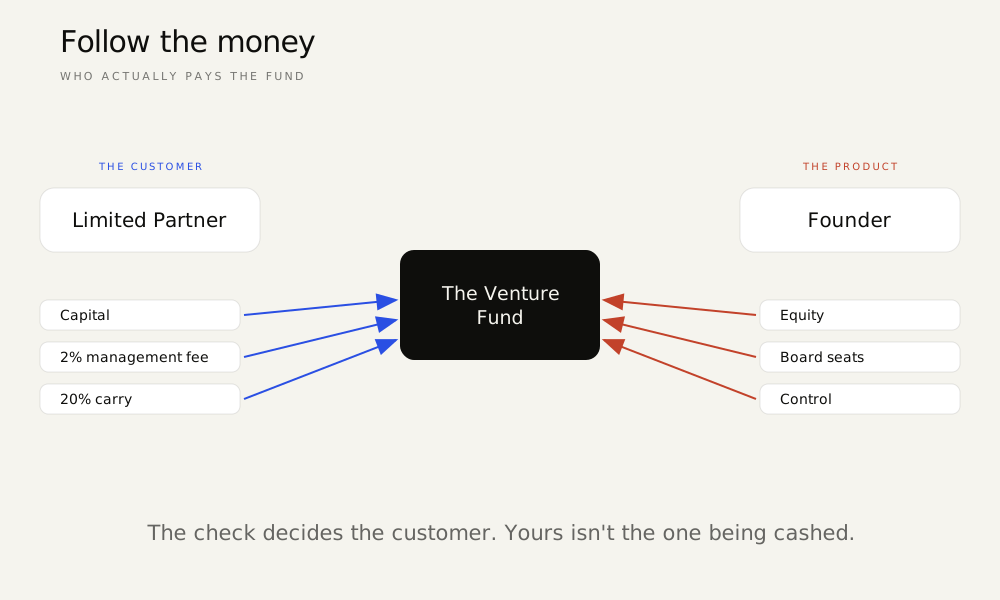
This isn't cynicism, it's just the org chart. A GP who returns 3x to their LPs raises a bigger next fund, so gets more money. A GP who is beloved by founders but returns 0.8x does not raise again. The incentive points in exactly one direction, and it doesn't point at the founder unfortunately. As a founder you are the thing being sourced, packaged into a portfolio, and sold — at a markup — to the people the firm actually works for: The LPs.
Which would be fine, if you (the product) were getting a fair deal. But you aren't.
The Founder's deal is terrible
Look at what the founder actually signs up for.
The pay is below market. A seed-stage CEO pays themselves about $153,000 a year in 2026.2 A senior engineer at a large tech company clears more than double that in cash alone, before liquid-equity and cash bonuses. The founder, on the other hand, takes the discount in exchange for illiquid startup equity — equity that, as we'll see, has a coin-flip-of-a-coin-flip chance of being worth anything.
The hours are punishing. Survey data puts a majority of founders north of 80 hours a week, with a meaningful slice past 100.3 That's two full-time jobs, paid at a discount to one.
And the base rate is brutal. Harvard Business School's Shikhar Ghosh, working from a dataset of roughly 2,000 venture-backed companies, found that about 75% never return cash to investors, and in 30–40% of cases the investors lose their entire stake.4 When the investors — the ones at the top of the stack — lose everything in nearly half the cases, ask yourself where that leaves the person at the bottom of the stack who takes money out last.
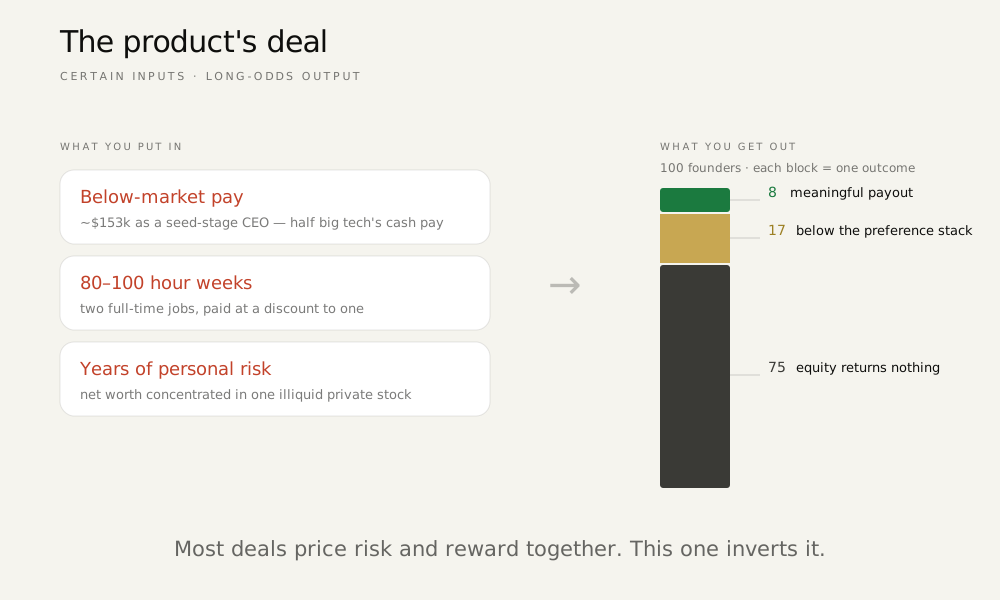
Most professions price risk and reward together: take more risk, demand more expected return. The founder's deal inverts it. They take the most concentrated, most illiquid, highest-variance personal bet available in modern finance — and they sit behind every preferred shareholder in line for the payout.
And even when you win, you can lose
But the part that should end the "founders are our priority" pitch for good: A founder can build a company, sell it for hundreds of millions of dollars, and still walk away with nothing.
That's not a hypothetical. When FanDuel sold for roughly $465 million, two investors held liquidation preferences entitling them to the first $559 million of any exit — more than the entire sale price. The preferred stack ate the whole thing. The founders and employees got zero.5 A nine-figure outcome, and the people who built it only got their LinkedIn updated.
Liquidation preferences are a contractual promise that the VC gets their money back — sometimes a multiple of it — before common shareholders see a cent.5 Stack enough rounds of them on a cap table and the founder needs a spectacular exit just to clear the hurdle and reach a dollar of their own.
And if the exit isn't spectacular? Founders often aren't around to find out. Noam Wasserman's research on thousands of startups found that nearly 60% of founder-CEOs are replaced within their first four years, and fewer than 25% lead their company all the way to an IPO.6 Every financing round raises the odds of replacement, because the board — controlled by the people who wrote the checks — decides who runs the company. The founder builds the thing. The board decides whether the founder gets to keep building it.
So the full deal reads: below-market pay, inhuman hours, a 75% chance of zero, a preference stack that can swallow a winning exit whole, and a board that can fire you on the way up. And the industry has somehow convinced a generation of the most talented, ambitious people alive that this is normal. That it's the price of admission. That they should be grateful for the term sheet.
It shouldn't be normal.
And it doesn't have to be.
Could a VC firm actually serve founders?
Here's the thought experiment. What would a venture firm that genuinely put founders first actually look like?
The answer falls out of the org chart above. If the customer is whoever writes the check, then the only way to make founders the customer is to never take a check from anyone else. No pension funds. No endowments. No outside LPs. One constituency, served exclusively: founders.
Which runs straight into the obvious problem: Founders — especially at seed — don't have cash 🤷. And the ones who do are rightly pouring it into their own companies, not into a venture fund. So a founder-only fund sounds lovely, but impossible in the same breath.
Unless you stop asking founders for the currency they don't have (cash), and instead start accepting the one they do have: Equity.
A founder's primary asset isn't cash. It's equity in their own startup. So the move is to build a venture firm that never takes a dollar of outside capital, and instead accepts seed-stage equity as the "LP stake" — then reinvests and compounds the proceeds from that equity, across hundreds of founders and many years, into a real, large, permanent cash base. The founders are the limited partners. They just fund their stake in the only currency they have to spare: equity instead of cash.
But it turns out, this model might have some super powers. If you get that right, three things happen that no traditional venture fund can replicate.
You can actually help. A firm holding equity in hundreds of founders' companies has a standing network of hundreds of founders. That's a board member when a portfolio company needs one, an advisor to parachute in on a hard problem, and — most underrated of all — a roster of companies that can be each other's first customers. Traditional VCs talk about "platform value." This is platform value that compounds with every marginal founder who joins.
You can see the whole field. Equity exposure across hundreds of companies is a god's-eye view of the private market — more ground-truth signal on what's working, who's hiring, which categories are heating up, than almost any investor alive. In the land of the blind, the one-eyed-man is king. So that information is a structural edge in picking winners. And in the highly opaque and inefficient Venture Capital market, a small edge like that can be the difference between consistent mediocre vs consistent top-quartile performance.
You can win more deals. When the founders of the hot companies are already your members, you get into the competitive rounds others can't. And because of the network above, you can help those companies outperform once you're in. Better selection, better access, better support — the three things that actually drive venture returns, all pointing the same way for once.
And you can do all of the above while actually treating founders as your number 1 priority.
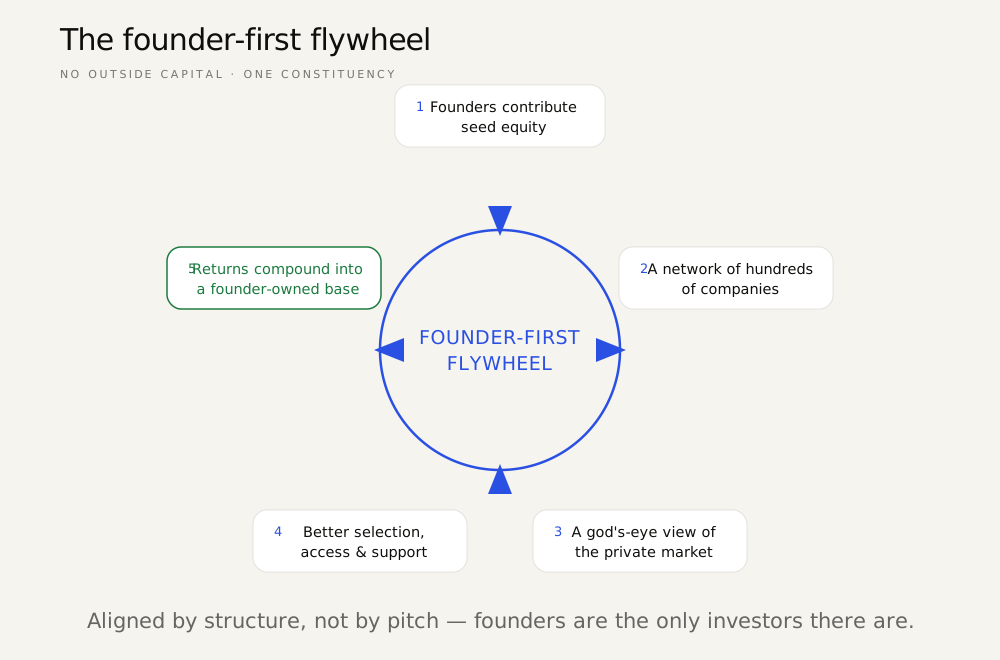
A firm built this way doesn't just claim to serve founders. Its entire economic engine depends on founders doing well, because founders are the only investors it has. The interests don't need to be aligned by a pitch. They're aligned by the structure. Incentives drive outcomes.
So, we’re doing it...
The venture industry's greatest trick was convincing founders they were the priority, when the LP was always the customer and the founder was always the product. Once you follow the money, you can't unsee it — and you can't unsee how raw the founder's deal really is.
Rising Tide is building the other thing: the first venture firm that takes no outside capital, serves founders and only founders, and — precisely because of that constraint — gets a set of unfair advantages no LP-funded fund can copy. We think it will outperform most of the industry. And in the process, it can build real, generational wealth for a whole generation of founders — including the ones whose own startups don't make it.
That's the Founder Wealth Ladder: a path that starts at your seed round, and compounds for decades, whether or not your first company even makes it, resulting in the potential for true, generational wealth creation, seeded by your own seed equity; regardless of the performance of your own startup. We've written before about why the person taking all the risk is the only one on the cap table without a parachute. This is what we're doing about it.
You were never supposed to be the product. Come be the customer.
References
[1] On the standard "2 and 20" venture fund economics — a ~2% annual management fee on committed capital plus ~20% carried interest, both paid out of limited-partner capital and profits: Investopedia, "Two and Twenty (2 and 20) Hedge Fund Fees." The same fee structure is standard across venture capital. investopedia.com
[2] On 2026 venture-backed founder/CEO cash compensation, including the ~$153,000 average seed-stage CEO salary: Kruze Consulting, "Startup CEO Salary Report." kruzeconsulting.com
[3] On founder working hours, including survey data showing a majority of founders working 80+ hours per week and a meaningful share exceeding 100: aggregated founder-hours reporting (CB Insights / Forbes survey data). Figures vary by company stage; early-stage founders skew highest. barawave.com
[4] Shikhar Ghosh (Harvard Business School), analysis of roughly 2,000 venture-backed companies: about 75% never return cash to investors and 30–40% liquidate with investors losing their entire investment. Reported in "The Venture Capital Secret: 3 Out of 4 Start-Ups Fail," The Wall Street Journal / Harvard Business School News. hbs.edu
[5] On liquidation preferences and the FanDuel exit — a ~$465M sale in which preferred investors' ~$559M preference stack left founders and employees with $0: Equidam, "How to Exit for $1B and Walk Away With Nothing," and Pipeline, "Liquidation Preference: Definition, Examples & How It Works." equidam.com · pipelineroad.com
[6] Noam Wasserman, The Founder's Dilemmas, and "The Founder's Dilemma," Harvard Business Review (Feb. 2008): nearly 60% of founder-CEOs are replaced within four years, fewer than 25% lead their company to an IPO, and the probability of replacement rises with each financing round. hbr.org
This piece is commentary, not investment, legal, or tax advice. EFLF and the other Founder Wealth Ladder products are private offerings subject to eligibility and standard securities-law restrictions.