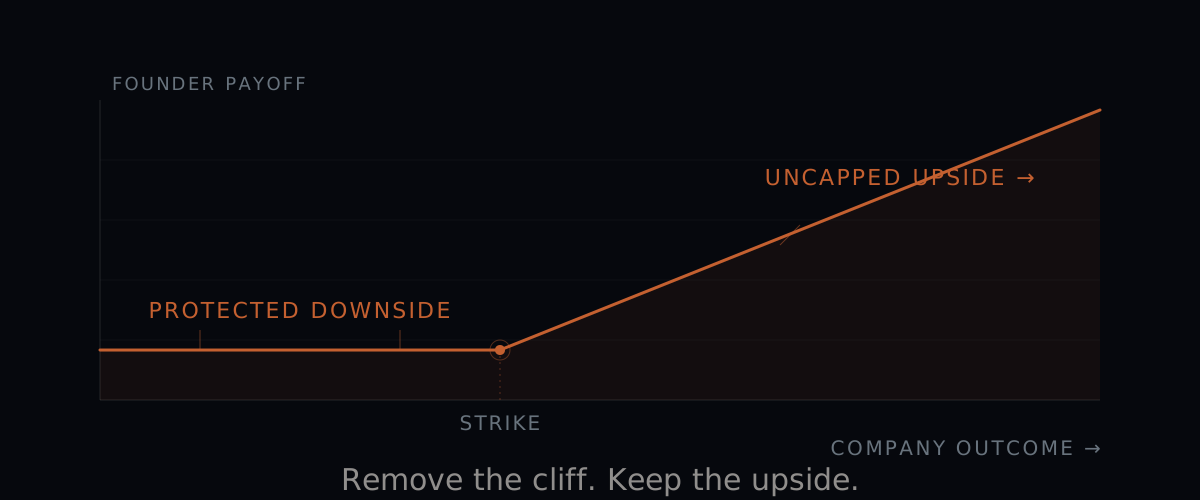
The single most common pushback we hear on our founder downside-protection products (EFLF, EFDPF, and ECLF) goes like this: if you hand founders downside protection, they'll stop trying so hard. The implication is that venture capitalists should be against any product that takes risk off the founder's personal balance sheet — that a hungry founder is a high-performing founder, and a comfortable founder is a coasting one.
It's an intuitive argument. It's also asinine, wrong, and treats founders as pawns.
The data on how venture returns are actually generated, combined with three decades of academic work on how humans respond to financial risk, points to the opposite conclusion: founders with personal downside protection are more likely to do the thing their investors actually need them to do. Which is swing hard.
The shape of venture returns
Start with the math that every GP knows in their bones and every LP has memorized.
Venture is not a base-hit business. It is a grand-slam business. Horsley Bridge's analysis of ~7,000 of its investments from 1975–2014 found that 6% of deals produced 60% of total returns, and a full 65% of deals returned less than the capital invested.1 AngelList's own data on its seed-stage portfolio shows the same heavy-tailed shape — the top decile of investments generates the overwhelming majority of dollar returns.2
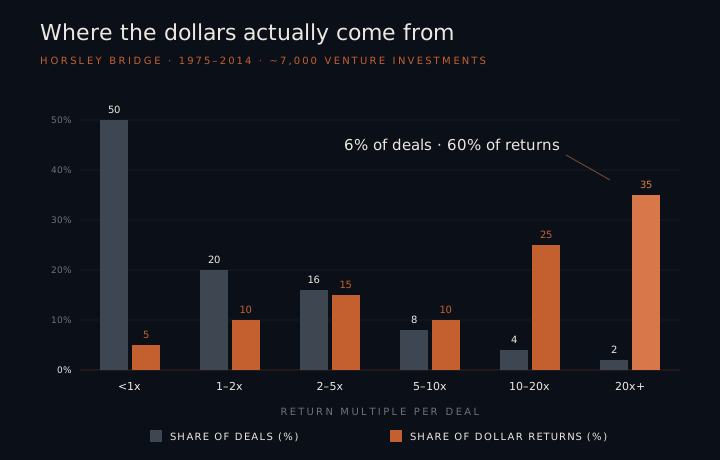
The kicker — and this is where the intuitive "founders should feel the pressure" argument starts to break — is what Chris Dixon at Andreessen Horowitz calls the Babe Ruth Effect: the best venture funds have more strikeouts than mediocre funds, not fewer.3 Great funds lose money on more deals than good funds do. They just hit harder on the wins.
Put differently: the difference between a top-decile fund and a mediocre one is almost never that the top fund avoided more losers. It's that the top fund had a 70x outcome where the mediocre fund had a 10x outcome — and to get the 70x, you have to consistently back the kind of company-level decisions that could go to zero.
This is the part of the math that founders, GPs, and especially first-time LPs all struggle with: a portfolio full of solid 3–5x companies is a worse outcome for a venture fund than a portfolio with a 50x winner and a stack of total losses. The hits-driven math means the fund's job is not to minimize failures — it's to maximize the size of the wins. The strikeouts are tolerated, sometimes even celebrated, as the price of admission for swinging at pitches that could carry the fence.
What the VC actually wants the founder to do
Once you've internalized the power law, the VC's actual preference function clicks into place. They don't want a company that finds a polite niche and grows 30% a year forever. They want the company that has a 40% chance of dying, a 40% chance of muddling along, and a 20% chance of becoming a generational outlier — because the expected value of that path beats the safer one by an order of magnitude.
Which means the operating decisions a VC quietly hopes their founder is making look like this:
- Burn the moat-building cash now instead of holding it for runway insurance.
- Hire the senior exec who is too expensive but might unlock the next-stage market.
- Bet the product roadmap on the bigger, less-proven thesis.
- Take the cross-Atlantic launch a year early instead of perfecting the home market first.
Every one of those is a swing. Every one of them raises the variance of the outcome distribution. And every one of them is exactly what the VC's portfolio math needs from this company in order for the rest of the fund's losers to be paid for. So, by correlate - the VC fund needs the founder to be making those swings.
Where the pushback comes from — and why it misfires
So why does the "downside protection makes founders soft" argument keep getting trotted out? Because it conflates two different kinds of risk that should be kept rigorously separate:
- Founder risk — the risk to the founder's personal financial life. House, family, kids' college fund, the next ten years of their working life.
- Company risk — the risk profile of the operating decisions the founder makes inside the business.
The pushback assumes these are the same lever, just labeled differently. They are not. They pull in opposite directions.
This is not speculation. It's well-documented in behavioral economics. Kahneman and Tversky's prospect theory established decades ago that humans are not generic "risk-averse" — they are loss-averse, weighting potential losses roughly 2x more heavily than equivalent gains.4 A 2022 study in Finance Research Letters extended this directly to entrepreneurial decision-making, finding that loss aversion explains entrepreneurial risk choices better than standard risk aversion models.5
The implication: when a founder has 100% of their net worth locked inside one illiquid private stock, every decision inside the company is being filtered through a loss-aversion lens. The asymmetric pain of "I lose everything" makes the safer path look enormously more attractive than its expected value would suggest. This is the founder version of disposition effect — and it's pointing the founder in exactly the wrong direction relative to what the VC investors actually need.
Separating the two risks
The fix is not to ask founders to override their humanity. It's to remove the personal financial exposure that is creating the loss-aversion distortion in the first place.
This is the operating thesis behind every founder-liquidity product Rising Tide has launched:
- EFLF lets seed-stage founders diversify a slice of their company stock into a basket of their cohort, so their personal outcome is no longer 100% binary on one company.
- EFDPF gives Seed-through-Series-C founders an actual downside floor — a put-like protection on their position that caps their personal disaster scenario.
- ECLF does the same diversification trick at late-stage, where founders are often sitting on nine-figure paper net worths that they cannot touch and cannot afford to lose.
In all three cases, company risk is unchanged. The founder still owns most of their equity. The cap table still works. The board still pushes for growth. What changes is the founder's personal risk profile — and with it, the loss-aversion overlay sitting on top of every operating decision. In essence, because the founder feels more comfortable losing money, they are more likely to take the bing swings .
The academic backing for this is not new. Gustavo Manso's 2011 paper in the Journal of Finance, "Motivating Innovation," is the canonical work here.6 Manso shows formally that contracts that maximize innovation and exploration require tolerance for early failure — and that pay-for-performance schemes with hard downside cliffs systematically push agents toward exploitation of the known rather than exploration of the new. Basically - if you want people to do truly novel things, make sure they don't feel the pain of a failure. The corporate-finance literature backs this up — Tian and Wang's "Tolerance for Failure and Corporate Innovation" is a good companion read — it found that startups backed by more failure-tolerant VCs produced more and better patents.7
Translation: the structural recipe for getting more big swings out of a founder is to remove the personal cliff they're standing on, not to make the cliff steeper.
A hypothetical example
Two founders. Same company. Same cap table. Same Series B that ran a bit long. Cash is tight. Eighteen months in, the company has a choice:
- Path A — the safe exit. Accept the acqui-hire from a strategic. $40M total. Founder walks with $6M. Investors recover ~0.8x. Everybody is professionally fine but nobody is happy.
- Path B — the burn-the-ships swing. Take one more round at a flat valuation, throw the cash at the AI infrastructure thesis the team has been pitching internally for a year, and either become a $2B+ outcome in 36 months or run out of money trying.
Founder #1 has 100% of their net worth in this stock. No house equity to fall back on. Spouse just left a corporate job to help with the kids. Path A doesn't feel great — but Path B feels like betting the family. Prospect theory says they're going to take Path A almost regardless of the expected value calculation, let alone how would they even push Path Be through the "spouse test". So they take the safe acquihire, and the VC ends up holding a 0.8x outcome.
Founder #2 sold 5–10% of their position into a diversified founder-liquidity product two years ago. Their kids' college is funded. Their mortgage is paid. They are not going to be financially destroyed if the company goes to zero. Because of that, Path B is a serious option for them. The personal worst case is "I have to find a new job in 18 months," not "we lose the house." So they take the swing.
Which founder did the VC actually want, on the day they wrote the check?
The wager
We think the pushback we keep getting — "downside protection will make founders lazy" — gets the entire setup backwards. It treats the founder as some sort of input-output-robot entity and assumes that piling personal risk on them will translate into more aggressive company-level decisions. However, the behavioral and empirical literature both say the opposite: piling personal risk on a founder creates loss aversion, and loss aversion is the single biggest mechanism by which venture-backed companies end up in mediocre outcomes that don't pay for the rest of the fund.
The right way to get bigger swings out of founders is to take the cliff out of the personal scenario, not to make it steeper.
That's the entire bet behind why we're building sophisticated financial products to give Founders downside protection. Safer founders equal bigger outcomes.
References
[1] Andreessen Horowitz, "Performance Data and the 'Babe Ruth' Effect in Venture Capital," citing Horsley Bridge Partners data on ~7,000 investments, 1975–2014. a16z.com
[2] AngelList, "What AngelList Data Says About Power-Law Returns in Venture Capital." angellist.com
[3] Chris Dixon, "The Babe Ruth Effect in Venture Capital," June 2015. cdixon.org
[4] Kahneman, D. and Tversky, A., "Prospect Theory: An Analysis of Decision under Risk," Econometrica 47 (1979). Foundational treatment of loss aversion (≈2x weighting of losses vs. equivalent gains).
[5] Morales-Acevedo, P., "Loss aversion and risky entrepreneurship," Finance Research Letters 48 (2022). sciencedirect.com
[6] Manso, G., "Motivating Innovation," The Journal of Finance 66, no. 5 (2011): 1823–1860. Argues formally that optimal innovation-motivating contracts exhibit substantial tolerance for early failure. web.mit.edu/manso
[7] Tian, X. and Wang, T., "Tolerance for Failure and Corporate Innovation," Review of Financial Studies 27, no. 1 (2014): 211–255. Empirical finding that startups backed by more failure-tolerant VCs produce more and higher-quality innovation.
This piece is commentary, not investment advice. EFLF, EFDPF, and ECLF are private offerings subject to eligibility and standard securities-law restrictions.