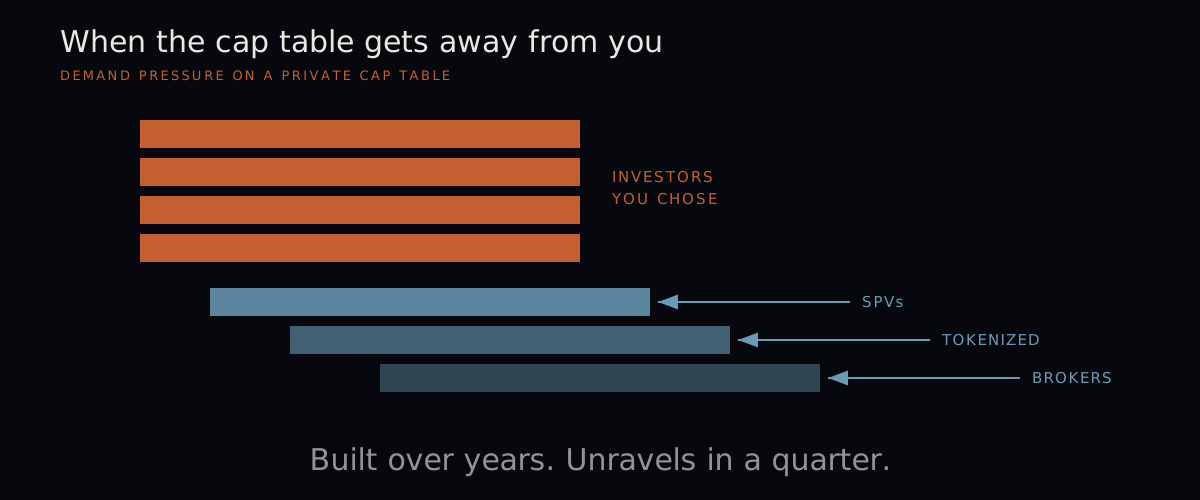
Right now, the hottest private companies in the world are watching their own shares trade in places they never authorized. Over the past month, secondary platforms, SPVs, and "tokenized" products have been quoting prices for Anthropic, OpenAI, and Scale AI stock to anyone with a checkbook — at implied valuations that, in Anthropic's case, ran as high as $1 trillion on one platform and $1.6 trillion across tokenized venues, against a primary round rumored at roughly $900 billion.12
That demand is a compliment. It is also a problem — and it is a problem most companies walk straight into.
The cap table starts to unravel
A good cap table is built deliberately. Founders spend years choosing investors: the ones whose names help in the next round, whose behavior in a downturn is known, whose logos belong on the S-1. Then the company gets hot — and that careful work starts coming apart at exactly the moment it matters most. The run-up to an IPO is when every regulator, banker, and prospective public investor looks hardest at who owns what.
That is why, in May 2026, both Anthropic and OpenAI did something unusual. They publicly declared war on their own secondary markets. Anthropic posted a notice stating that "any sale or transfer of Anthropic stock, or any interest in Anthropic stock, that has not been approved by our Board of Directors is void and will not be recognized on our books and records," and named eight platforms — Forge Global, Hiive, Sydecar, Upmarket, and others — as unauthorized.12 OpenAI issued comparable guidance treating transfers made without written consent as invalid.2
Read that again. Two of the most valuable private companies on earth had to issue legal warnings about their own stock. The word they chose — "void," not "voidable" — was deliberate; under Delaware law it strips defenses from downstream buyers and signals a willingness to litigate.2 Nobody wants this to be their communications strategy. But you’re left with few options if your cap-table runs away from you.
Why this happens: a war on three fronts
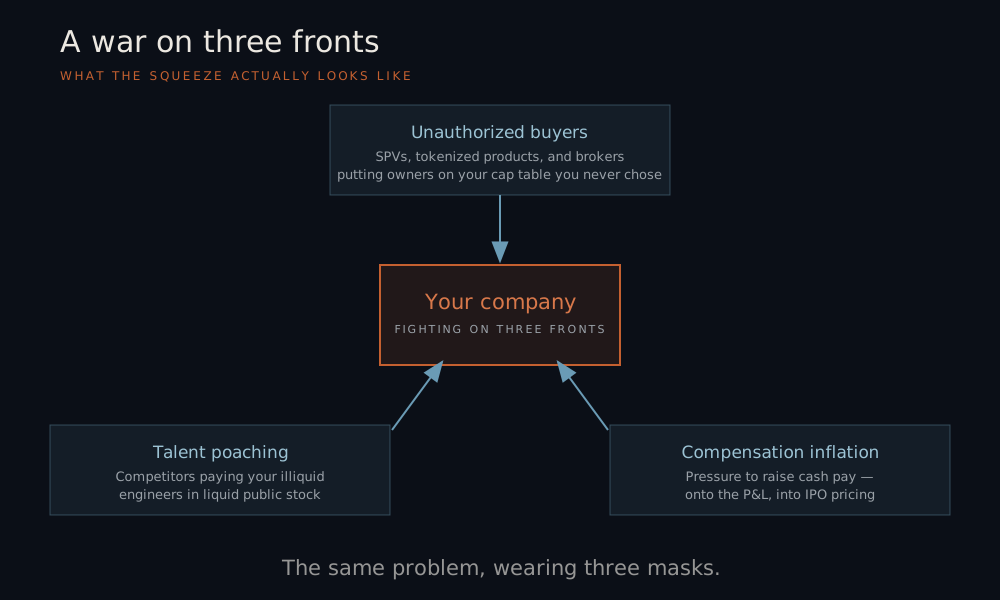
It happens because of a squeeze almost no company sees coming until it's already inside the maelstrom. Three forces arrive at once:
The outside. Success makes your equity the thing everyone wants. Brokers, SPVs, and tokenized-product issuers will manufacture access whether you authorize it or not — one platform alone, Unicorn Exchange, reported more than $1 trillion in aggregate buyer demand for AI shares in a single quarter.2 Every one of those workarounds puts an owner on your cap table you did not choose. And the better your company performs, the bigger this problem is. Most worryingly, these secondary markets have REAL negative impact on any IPO process you want to run.
The inside. Your most valuable engineers are sitting on enormous paper net worth they cannot spend, cannot borrow against, and cannot diversify. That is psychologically unstable on its own, well before anyone calls them.
The competition. Now add a rival whose recruiters call those same engineers every week — and who pays in liquid, public stock. Your illiquid paper is suddenly competing head-to-head with their tradeable shares.
So you are fighting on three fronts at once: keeping unauthorized buyers off the cap table, keeping your best people from being poached, and — because the first two hurt — feeling pressure to raise cash compensation, which lands straight on the P&L and can complicate IPO pricing. None of these is independent. They are the same problem wearing three masks.
And here’s the worst part: you didn't have to be here. The squeeze is a failure of foresight, not of strategy. If the tools had been in place early, employee liquidity could have been a recruiting advantage — a reason to join and a reason to stay — instead of this three-front war.
How the best operators get ahead of it
A small number of companies do get ahead of it. The clearest example is Elon Musk's companies.
Musk's operating constraint was simple: for business reasons, he did not want to pay large cash salaries. So instead, SpaceX, BoringCo, Neuralink all built a standing program — roughly semiannual tender offers — that lets employees sell a defined portion of their shares at each new financing valuation. For SpaceX the July 2025 window cleared around $1 billion in stock; by late 2025, employees were selling at an approximately $800 billion valuation, double the level just six months earlier.3
The elegance is in what the company gets back. It knows exactly who is buying, so the cap table stays curated rather than colonized. Employees get real liquidity, which means they will accept below-market cash salaries — preserving the runway that actually determines whether the company survives. And liquidity becomes a retention tool instead of a recruiting vulnerability.
Three birds, one stone. But that’s Elon. As fantastic as we might all be as founders, we’re not all the richest person on the planet.
Where the Musk playbook strains
Two problems.
You are not Elon. SpaceX can run a tender because buy-side demand is overwhelming and the brand carries the round. Try the same program at an ordinary Series B and the secondary demand is not there yet — which means, by definition, you are selling employee shares at a discount. The mechanism that protects the cap table at SpaceX scale can quietly destroy employee value at startup scale.
The tax treatment is poor. This is the part that costs employees the most, and it has three layers.
Short-term versus long-term. Shares held a year or less are taxed as ordinary income on sale — a top federal rate of 37%, plus the 3.8% net investment income tax. Hold for more than a year and the same gain is long-term: 20% at the top, plus the same 3.8%.4 Same shares, same sale, roughly 17 points of difference — decided entirely by the calendar.
QSBS. Qualified Small Business Stock under Section 1202 is the big one. Stock held long enough in a qualifying company can have its gain fully excluded from federal tax — historically up to $10 million per taxpayer after a five-year hold; under the 2025 OBBBA changes, a tiered version (50% excluded at three years, 75% at four, 100% at five) with the per-taxpayer cap raised to $15 million.5 An employee who sells in an early secondary, before the QSBS clock has run, can forfeit a seven- or eight-figure exclusion. The secondary that felt like a win becomes the most expensive financial decision of their life.
ISOs versus NSOs. And the problem starts before the sale. Non-qualified options (NSOs) are taxed as ordinary income on the spread at exercise; incentive stock options (ISOs) are not taxed for regular income at exercise at all, and a qualifying hold turns the entire gain into long-term capital gain.6 The instrument matters as much as the timing.
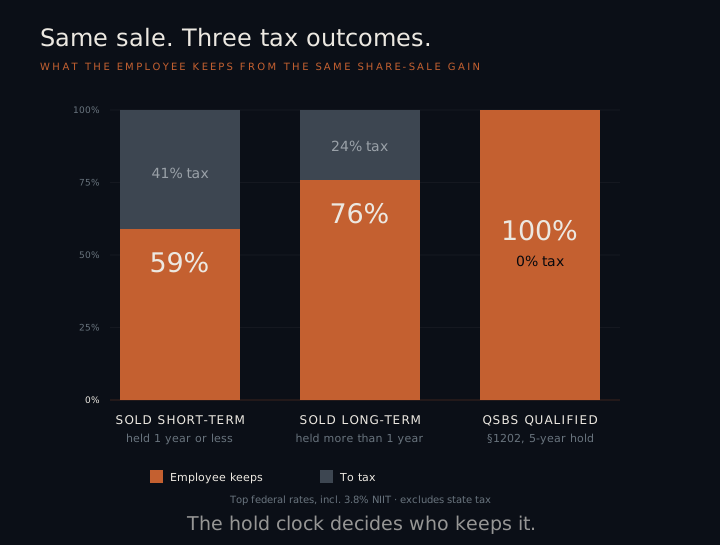
The Musk model (if you can get it!) solves the cap-table problem. But it doesn't solve the tax problem. An employee in a poorly timed, poorly structured secondary can hand 40 cents of every dollar to the IRS that a patient, well-structured holder would have kept.
Three birds, one stone — if you plan for it
Strip it back, and the opportunity is straightforward. A company that treats employee liquidity as infrastructure — not a fire drill — gets to do three things at once.
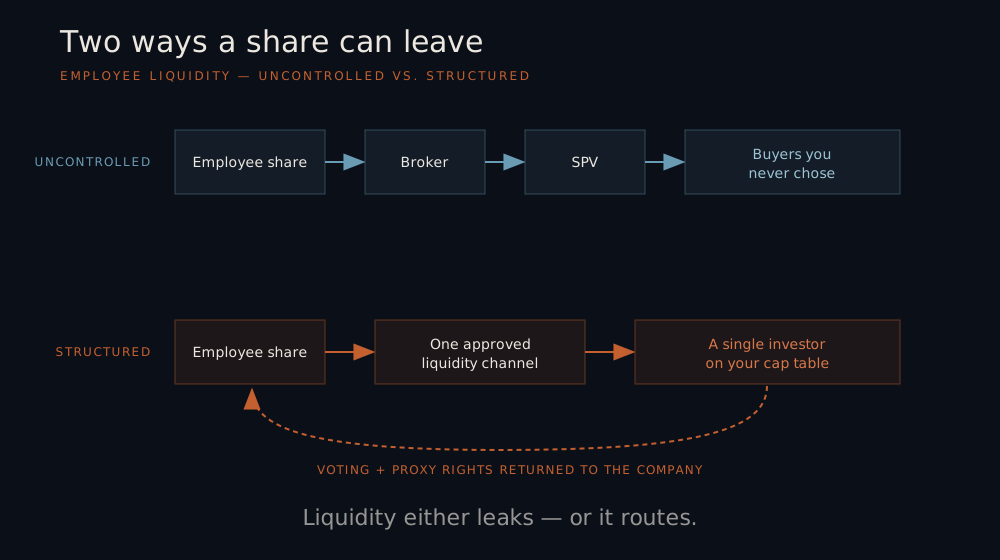
It keeps its best people, who are no longer comparing illiquid paper against a competitor's tradeable stock. It keeps paying scrappy-startup-level cash salaries, because the liquidity is coming from somewhere else — protecting the runway. And it keeps the cap table clean, because liquidity flows through a channel the company controls instead of leaking out through SPVs and brokers.
The reason most companies don't do this is not that they don't want to. It's that they can’t. The off-the-shelf tools haven’t existed in the past. Running a SpaceX-style program takes SpaceX-style demand and a dedicated internal team; doing it tax-efficiently takes structuring expertise most companies simply can’t afford to have in-house.
Why we built the ECLF
This is the gap the Exceptional Company Liquidity Fund is built to close. We have written before about why founders — and the people who build alongside them — deserve the kind of protection the rest of the cap table already has. The ECLF is that idea pointed at the cap-table-control problem.
It is an off-the-shelf liquidity channel. It gives employees and founders earlier liquidity, in tax-optimized forms — lending against the position and §351 conversions rather than a blunt taxable sale — through a single investor on your cap table who signs all voting and proxy rights back to you. We are not interested in control, or in meddling in how you run your company. And it is built to grow with you, from around the Series B through to pre-IPO.
The companies issuing legal warnings about their own stock did not choose chaos. They just did not get ahead of it. The tools to get ahead of it now exist.
References
[1] Ram Iyer, "Anthropic warns investors against secondary platforms offering access to its shares," TechCrunch, May 12, 2026. techcrunch.com
[2] "Anthropic and OpenAI Void Unauthorized SPV Share Transfers," Let's Data Science, May 12, 2026 — compiling Anthropic's support-page notice and reporting from Decrypt, Cryptopolitan, and Spendnode, including secondary-implied valuations near $1.0T (Forge) and up to $1.6T (tokenized venues), and the legal "void vs. voidable" distinction under Delaware law. letsdatascience.com
[3] On SpaceX's roughly semiannual employee tender program and rising secondary valuations: "SpaceX tender offer caps standout year for secondary sales," PitchBook; SpaceX IPO and tender-offer planning guides, Augustus Wealth. pitchbook.com
[4] On short-term gains taxed as ordinary income versus long-term capital-gains treatment, and the 3.8% net investment income tax: Carta, "How Stock Options Are Taxed: ISO vs NSO Tax Treatments." Figures are top federal rates and exclude state tax. carta.com
[5] On Qualified Small Business Stock under Section 1202, the five-year holding period, the historic $10M exclusion, and the 2025 OBBBA changes (tiered 50/75/100% exclusion and a $15M cap for stock issued after July 4, 2025): "QSBS gets a makeover: What tax pros need to know about Sec. 1202's new look," The Tax Adviser, Nov. 2025. thetaxadviser.com
[6] On the tax distinction between incentive stock options (ISOs) and non-qualified stock options (NSOs), including ordinary-income treatment of the NSO spread at exercise and the qualifying-disposition holding periods for ISOs: Cooley GO, "ISOs v. NSOs: What's the Difference?" cooleygo.com
This piece is commentary, not investment, legal, or tax advice. Tax treatment depends on individual circumstances and is subject to change; consult a qualified advisor. EFLF, EFDPF, and ECLF are private offerings subject to eligibility and standard securities-law restrictions.